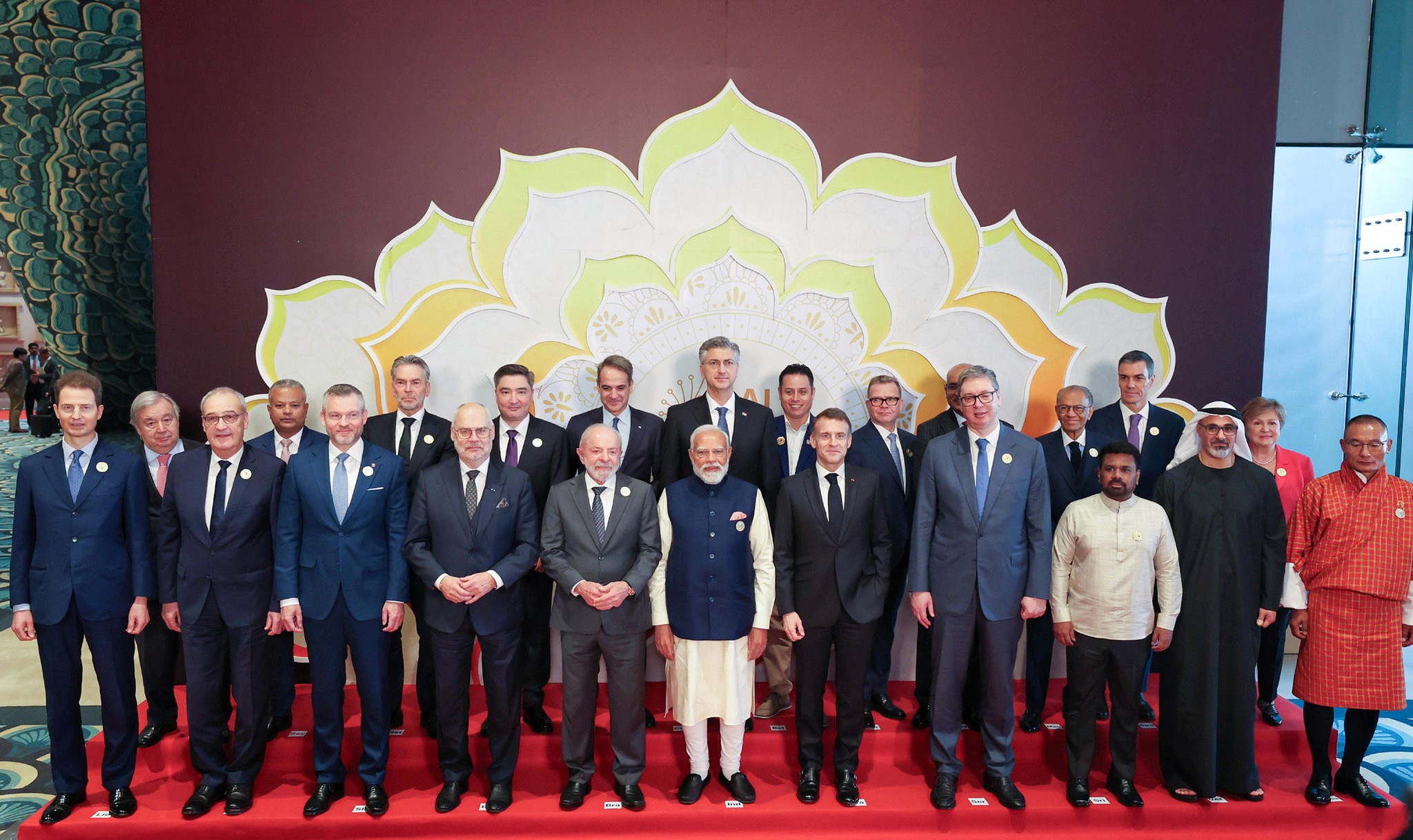


19 February 2026
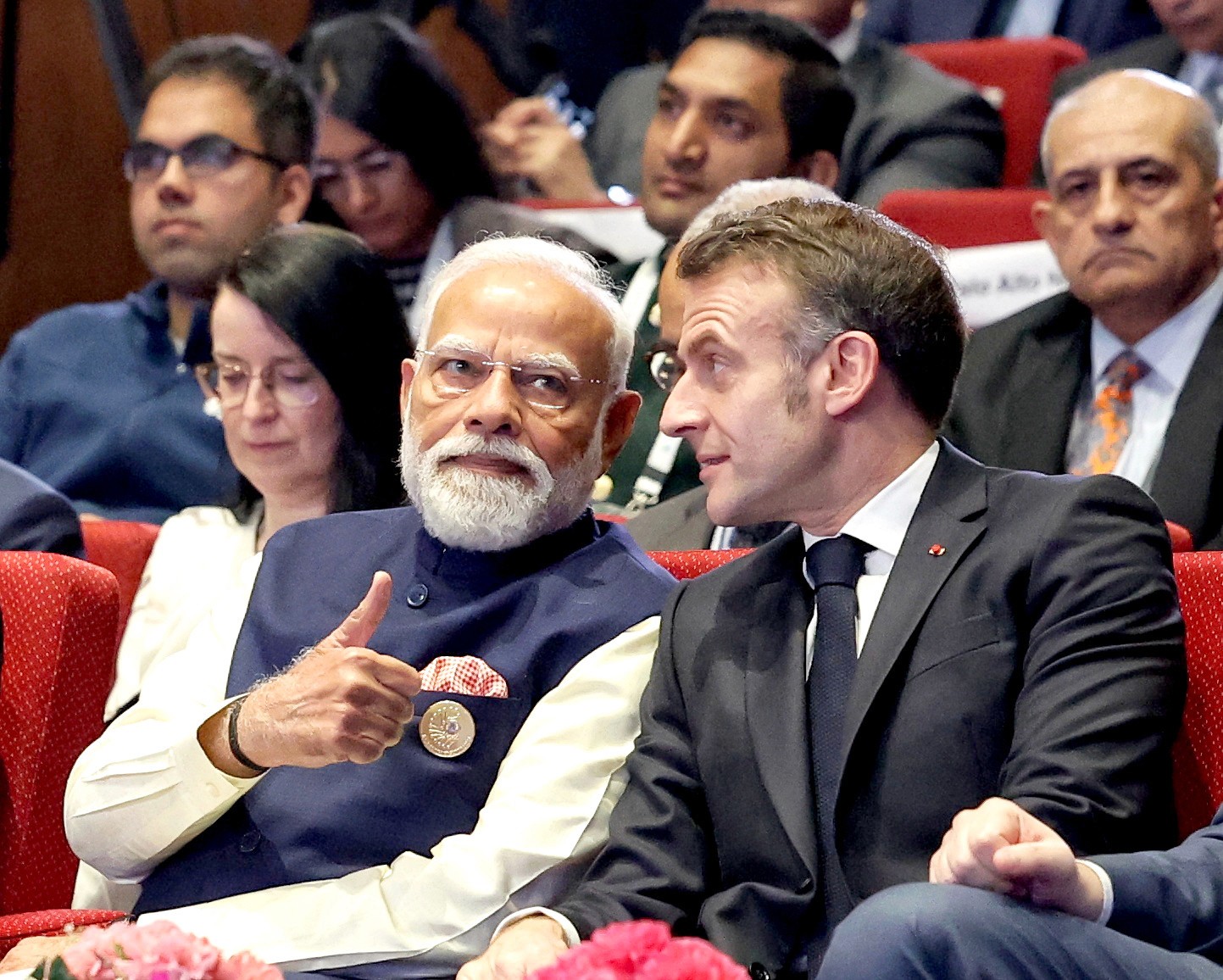
Mr. Prime Minister, dear Narendra Modi, heads of state and government, ministers, ambassadors, CEOs, ladies and gentlemen, Namaste.
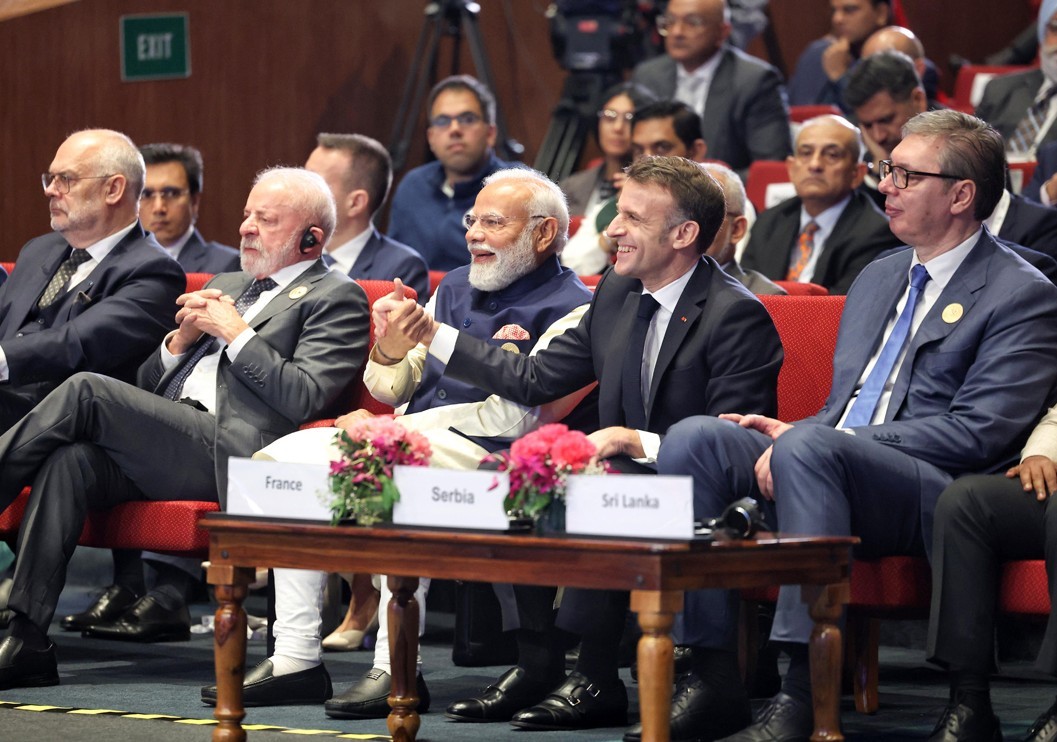
Thank you very much for welcoming us in this magnificent city, in this magnificent country. And it's great to be back after my 2024 state visit for this Artificial Intelligence Impact Summit hosted by you, Mr. Prime Minister.
I want to start with a story. Ten years ago, a street vendor in Mumbai could not open a bank account. No address, no papers, no access. And today the same vendor accepts payments on his phone, instantly. Instantly, for free, from anyone in the country. That is not just a tech story, that is a civilization story. And India built something that no other country in the world has built, a digital identity for 1.4 billion people. A payment system that now processes 20 billion transactions every month. A health infrastructure that has issued 500 million digital health IDs. Here are the results. They call it the India Stack Open Interoperable Sovereign.
That, dear friends, is what this summit is about. We are clearly at the beginning of a huge acceleration and you perfectly described it during your interventions. But let me just recap during one year what happened. Last year, when France and India co-hosted the AI Action Summit in Paris, we set a global guiding principle for a technology that would transform our societies and our economies. We say that artificial intelligence will be an enabler for our humanity to innovate faster, to disrupt healthcare, energy, mobility, agriculture, public services for the good of mankind. Both of us, we do believe in this revolution.
One year ago, the landscape started to shift. The US announced Stargate. China launched DeepSeek. AI has become a major field of strategic competition and big tech got even bigger. And some, a lot of them, are in this room and still accelerated during the last year. AI, GPU, chip tensions are now directly translated in geopolitical and macroeconomic terms. Sometimes for the best, sometimes for the worst, I have to say.
But clearly, one year ago, we demonstrated something else. Hegemony from any quarter is not a fatality. There is a path for innovation, independence, and strategic autonomy. And this path, I'm convinced, is what the countries like France and India must take together. And we have already achieved a lot. If we speak about models, you perfectly describe the acceleration and the diversity of these models. India made a deliberate sovereign choice. SML, small language models, task-specific, designed to run on a smartphone. And India built the first government-founded AI and deployed 38,000 GPUs at the cheapest rates to every startup in the country, as you perfectly described, Mr. Minister. We took a complementary path. We invested in European large language models.
Mistral, founded in Paris a little bit more than two years ago, is now valued at €12 billion, backed by Dutch leader ASML, German SAP, and French CMA CGM, serving over hundreds of major clients all over the place in Europe and elsewhere. They announced last week a new investment in a data center in Sweden and a new acquisition of KOYEB, building an actual European AI cloud. India chose granular and smart, and Europe chose sovereignty and scale. But both chose independence, and both were right. And this is as well the cooperation with LLMs coming from the U.S. and through cooperation, but cooperation based on mutual respect and independence, which could pave the way for progress.
After the model and the infrastructure, you just described all the infrastructure made by a lot of large companies in India, and all of us, we are building new infrastructure, computing capacity. One year ago in Paris, we announced $109 billion in AI investments, and we are delivering this project with a lot of data centers, €58 billion in 2025, powered by our decarbonated nuclear energy. With a great asset, and this is very important indeed, to have low carbon and available energy. Last year, France exported 90 terawatt hour of low carbon energy and pilotable energy, which is a huge opportunity to build faster and bigger data center.
At the European level, €200 billion has been committed. With the arrival of the Alice Recoque exascale supercomputer, key components of our AI factory ambition shared with the Netherlands and Greece, and we share the computer with them. Models, infrastructures, talents. India trains hundreds of thousands of AI engineers every year. With 500,000 engineers, India has the second largest developer community in the world. In France, we are doubling the number of AI scientists and engineers trained, and we have now more than 1,100 AI startups thriving in France, creating dozens of thousands of jobs. Harmattan AI, partnering with Dassault, Gradium for voice AI, Poolside, H, Hugging Face. I could quote the stories of these unicorns and large caps. And this is clearly one of our strengths.
In quantum computing, the next frontier, France is not placing one bet. We are placing four. Four technologies. Four French companies, Pasqal, Quandela, Alice and Bob, Quobly, and one ambition. To make Europe a quantum power. Which is also the ambition of AMI Labs, Advanced Machine Intelligence Labs, from our dear Yann Le Cun, for frontier research. The smartest AI is not the most expensive. It is the one built by the best people and for the right purpose.
Models, infrastructure, talents, capital, and adoption. This is where the Indian model is truly revolutionary, providing solutions for everyone in the country. From 200 million of Indian farmers in their own dialect, to travel advice for 400 million of pilgrims, or AI diagnostics for rural clinics, all running on India's digital public infrastructure. Open rates, near zero cost, adoption is key. And being inclusive is key.
In Europe, our AI factories optimize energy grids, transform logistics, reinvent healthcare administration, and we are proving you can build a competitive AI industry while protecting your citizens' data. And opposite to what some misinformed friends have been saying, Europe is not blindly focused on regulation. Europe is a space for innovation and investment, but it is a safe space. And safe spaces win in the long run. I'm sure of that.
Now, the point of this summit was not only to say, let's do more, it was to say, let's do better together. AI may be a powerful accelerator of productivity and a major shift for labor markets. This is why access to AI for all is critical. France and India share a common vision, a sovereign AI used to protect our planet and to foster prosperity for all. In health, we launched the Indo-French Institute for AI in Health, a partnership between Sorbonne Brain Institute and AIMS Delhi. And the partnership between H and St. John's Research Institute in Bangalore will use AI to transform hospital administration as well. In language, we jointly launched Current AI for Sustainable and Sovereign Access. And this year, we announced an open hardware tool for translation into Indian languages and dialects, because AI that doesn't understand dialects is not AI for all. And this is why we endorse this initiative for diversity in language.
In sustainability, our Coalition for Sustainable AI now has more than 200 supporters. Today with India and UNESCO, we launched an international challenge for sustainable AI models. Last year in Paris, we called it Action. This year in Delhi, we call it Impact. But the real name is simpler, AI Together. AI and digitalization will be a key theme for the months to come. And the key theme of the Africa Forward Summit we will have with Kenya in Nairobi in May. The continent, the African continent, with the youngest population that will double in 25 years, deserves the best digital tools. And at a time when tensions are rising, there is an increased sense of urgency to direct all our digital tools towards this inclusive approach. And in order, indeed, to be strong here in India, but to be strong as well on the African continent.
Let's focus all together towards bridging rather than dividing, creating rather than destroying, sharing rather than taking. France intends to use its G7 Presidency to foster that vision. I know, Mr. Prime Minister, that India will do the same through your BRICS Presidency. No country is bound to serve only as a market where foreign companies sell their models and download their citizens' data. No country.
One of our G7 priorities will be, as well, children's protection against AI and digital abuse. You just mentioned it, Mr. Secretary General. There is no reason our children should be exposed online to what is legally forbidden in the real world. Our platforms, governments, and regulators should be working together to make the Internet and social media a safe space. This is why, in France, we are embarking on a process to ban social networks for children under 15 years old. And we are committed here in this journey with a lot of several European countries being present here today. Greece, Spain. I know, Mr. Prime Minister, you will join this club. And this is great news that India will join such an approach in order to protect children and teenagers. And we stand ready to take all necessary actions to ensure that our young citizens are truly safe. And we wish to engage with all willing partners to make this vision happen for all. And this is a new coalition of willings in order to protect our children and teenagers. Protecting our children is not regulation, as well. It is civilization.
To conclude, the message I have come to convey is that we are determined to continue to shape the rules of the game. And to do with our allies, such as India, because we believe in core shared values. Science. Rule of law. Global balance. Efficient multilateralism. Innovation for the benefit of all. Now is the time to channel our forces toward what works. Concrete action and solutions that make AI more sustainable, efficient, and accessible. Targeted funding to leverage talents and creativity. Appropriate rules to prevent abuse and protect all our citizens. Strong partnerships that help build new AI solutions. More safe and more sustainable. I want to thank all the governments and business leaders present in this room and engage in this journey. I know your goodwill and your commitment in order to deliver these concrete results. We do believe in innovation, but we do believe in a better place, in a better world, as well. And I don't believe once again it's incompatible.
Let me say one more thing about partnerships, because this is not a two-player game. Last week, India and the UAE announced a joint AI partnership, a supercomputing cluster, shared data centers, and innovation corridor. And India brings the engineers and the frugal models, and the Gulf brings the capital and the infrastructure. And together, they build faster than either could alone. France knows this equation well. With the UAE, we engaged and committed billions of euros for innovation and data centers in our country, and this partnership creates more value together. This is not dependency. This is intelligent convergence between governments with companies, large caps, startups. This is clearly this intelligent convergence which can provide results. The old world said you compete or you lose. The new world says you connect or you fall behind.
I started with a story about a street vendor in Mumbai. Ten years ago, the world told India that 1.4 billion people could not be brought into the digital economy. India proved them wrong. Today, some say AI is a game only the biggest can play. That you need $400 billion to be in the race. That nothing can exist between the two blocks. India, France, Europe, together with our partners, those who believe in our approach, companies, governments, investors might have a different way. The money race is important, and we cannot discount it. But the outcomes and real value creation for our population is even more. The future of AI will be built by those who combine innovation and responsibility. Technology with humanity. And India and France will help to shape this future together. And the journey has just begun. Jai Ho ! Thank you.